 EN
EN  DE
DE 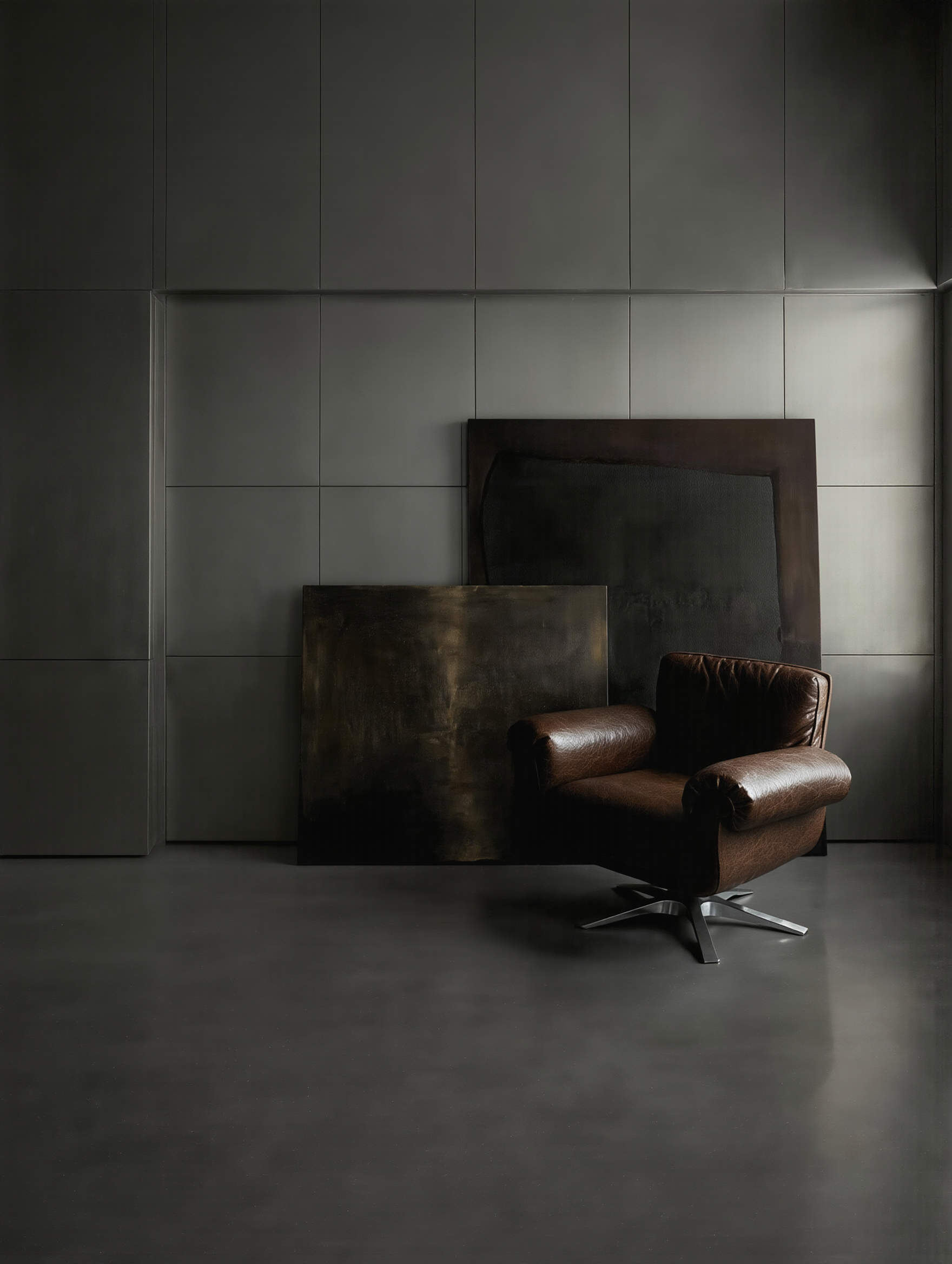
Brutalism in art emerged as a response to the cultural and physical rupture that followed the World War II. Artists of that time no longer trusted classical notions of beauty and harmony, as reality had become too harsh to be adorned. The term itself is connected to the concept of béton brut, introduced by Le Corbusier, meaning “raw concrete,” a material that does not conceal its nature.
In art, this led to a rejection of decoration and a search for direct, honest expression. Material ceased to be a neutral carrier of form and became part of the meaning itself. Artists employed rough textures, cracks, traces of damage, and industrial substances. Works often appear unfinished, yet this is a deliberate gesture in which the illusion of perfection is replaced by the presence of reality.
Damage as a form of truth
In this context, the practices of Alberto Burri are significant, as he worked with burned fabrics and plastics, turning damage into a visual language, as well as Jean Dubuffet, whose concept of art brut moved beyond academic norms and returned art to a primary, almost instinctive form of expression.
Brutalism in art does not aim to be beautiful in a conventional sense; it captures a state marked by tension, vulnerability, and truth. Paradoxically, the rejection of beauty produces a new form of aesthetics grounded in honesty and material presence. Today, interest in Brutalism is resurging, as the digital age creates a desire for something tangible, heavy, and real, something that cannot be smoothed over or filtered.
"THE INTERIOR IS PERCEIVED ALMOST AS A
SCULPTURAL ENVIRONMENT, REMOVING THE SUPERFLUOUS."
Structure as Visual Language
Brutalism in design and interiors develops the same principles but translates them into spaces where people directly encounter form and material. Its origins are likewise tied to the ideas of Le Corbusier and architects such as Paul Rudolph, for whom it was essential not to conceal structure or material. In such interiors, concrete remains concrete, metal is not disguised, and the building’s structure becomes part of the visual language.
Spaces are defined by massive geometric forms, restrained palettes of greys and dark tones, and a minimum of decorative elements. Light plays a crucial role, creating sharp contrasts and emphasizing surface textures. Despite its reputation as a cold and heavy style, Brutalism can evoke a sense of focus and inner strength, as it leaves only structure and material.
Authenticity in the Digital Age
In contemporary interpretations, the style is often softened through the introduction of textiles, wood, and living plants, creating a balance between rigidity and vitality. Its relevance today is linked to a growing fatigue with visual sterility and a renewed desire for authenticity, where value lies not in perfect surfaces but in depth and honesty of space.